

Last Updated: November 4, 2026
Quick Summary
Espresso water quality affects home espresso flavor more than most gear upgrades because minerals in the water decide which flavor compounds reach the cup. Aim for filtered tap water with moderate hardness and low alkalinity, then test and log your water monthly to keep shots consistent.
- Espresso is roughly 90% water, so water quality outweighs most gear upgrades.
- Magnesium binds to fruity, bright flavor compounds; calcium extracts but leaves more scale.
- Too much bicarbonate alkalinity leaves a flat, chalky cup no grind adjustment can rescue.
- A hardness test takes about two minutes using test strips or a liquid drop kit.
- Carbon filtration removes chlorine and odors without stripping the minerals that extract.
Table of Contents
- Why Water Quality Decides How Your Espresso Tastes
- Understanding Water Hardness and Mineral Content
- How to Run an Espresso Machine Water Hardness Test at Home
- What the SCA Water Quality Standards for Coffee Actually Require
- Finding the Best Water for Espresso: Tap, Filtered, or Bottled
- The TDS Myth and Why Temperature Changes Mineral Solubility
- Protecting Your Machine From Scale and Corrosion
- Pairing Better Water With Freshly Roasted Beans From Birdy & The Bear Coffee
- Frequently Asked Questions
Why Water Quality Decides How Your Espresso Tastes
Espresso is roughly 90% water, which means espresso water quality has a bigger impact on home espresso flavor than most gear upgrades you can buy.
Here's the part most guides get wrong: they treat water as a background detail. It isn't. The minerals dissolved in your water decide which flavor compounds make it into the cup and which stay locked in the puck. Change the water and the same beans can taste sweeter, duller, or sharply sour.
Below, we'll show you exactly how to read your water, fix what's wrong, and pair the result with beans worth the effort.
Understanding Water Hardness and Mineral Content
Water hardness is the measure of dissolved calcium and magnesium in your water, and those two minerals are the ones that pull flavor out of coffee grounds. Magnesium binds to fruity, bright flavor compounds with particular enthusiasm. Calcium does similar work but leaves more scale behind.
Total dissolved solids (TDS) describes everything dissolved in the water, not just the minerals you want. A high TDS reading can mean great flavor extraction or a cup full of things you'd rather not drink.
Bicarbonate alkalinity is the buffer, the part of your water that neutralizes acidity. Too little and your shot tastes sharp and thin. Too much and the acidity disappears, leaving a flat, chalky cup that no grind adjustment will rescue.
Think of it this way: hardness does the extracting, alkalinity does the balancing. Get both roughly right and your espresso starts behaving predictably.
How to Run an Espresso Machine Water Hardness Test at Home
An espresso machine water hardness test takes about two minutes and costs very little. Test strips are the simplest route; a liquid drop kit gives you more precision if you want it.
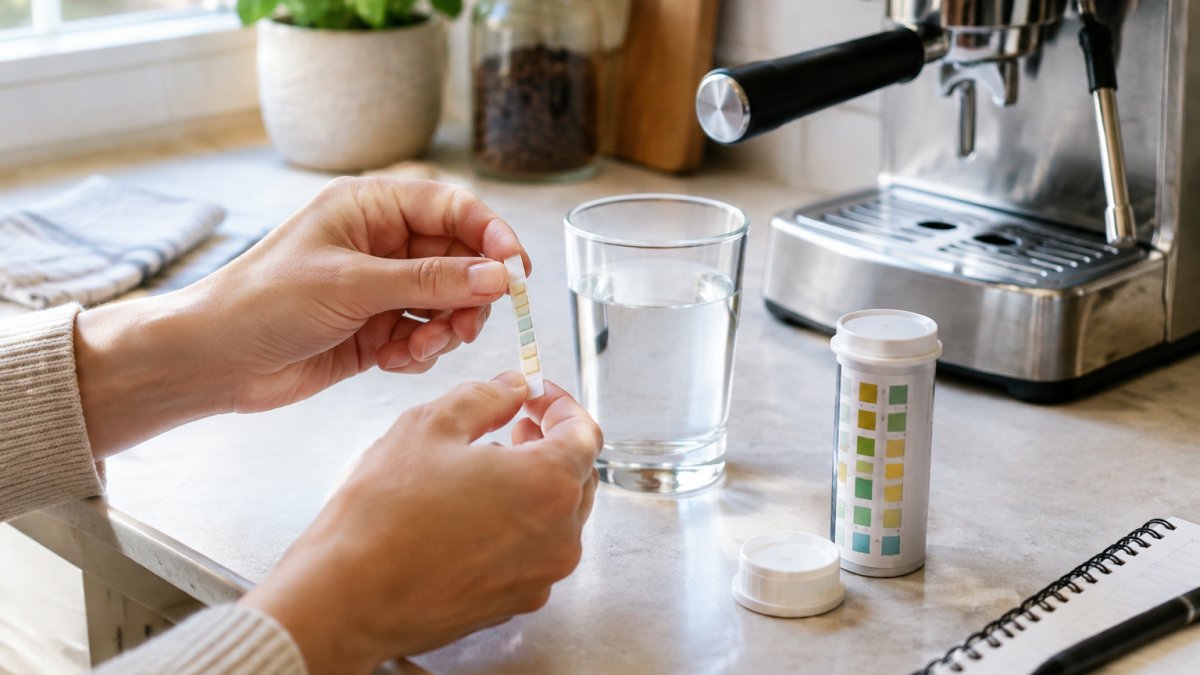
Here's how we'd do it:
- Fill a clean glass with the same water you brew with, not water from the machine's reservoir after it has sat for days.
- Dip the strip for the time the packet specifies, then shake off the excess.
- Wait for the color to develop and match it to the chart. Read it in daylight, not under warm kitchen bulbs.
- Write down the number and the date. Test again in a month, because municipal water shifts with the seasons.
Watch out: testing water straight from the machine tells you what's sitting in the boiler, not what you're putting in. Test the source.
A common mistake is testing once and assuming it holds forever. Water treatment plants change their source and their dosing, and your reading can move without any warning.
What the SCA Water Quality Standards for Coffee Actually Require
The Specialty Coffee Association publishes water standards that give home brewers a target to aim at. The SCA water quality standards for coffee set ranges rather than one magic number, which is genuinely useful because it tells you how much wiggle room you have.
Broadly, the standards call for water that is clean and odor-free, carries enough mineral content to extract properly, and stays low enough in alkalinity that acidity survives in the cup. They also cap the things that damage machines, like chloride and total hardness.
You do not need to hit every number exactly. What matters is landing inside the ranges and, more importantly, staying consistent.
If you want the exact figures, pull the current standard from the SCA directly rather than trusting a blog summary, including ours. Specifications get revised.
Finding the Best Water for Espresso: Tap, Filtered, or Bottled
The best water for espresso is filtered tap water with moderate hardness and low alkalinity, because it gives you consistent minerals without the chlorine and scale that municipal supplies carry.
Here's the trade-off in plain terms:
| Water option | What it gives you | The catch |
|---|---|---|
| Tap water | Convenient, cheap, mineral-rich | Chlorine, variable hardness, seasonal swings |
| Carbon-filtered tap | Removes chlorine and odors, keeps minerals | Doesn't soften hardness |
| Reverse osmosis | Near-total mineral removal | Flat-tasting shots; needs remineralizing |
| Bottled spring | Consistent, drinkable mineral profile | Cost adds up; profiles vary by brand |
| Distilled plus minerals | Full control over the profile | Requires mixing; easy to get wrong |
Carbon filtration is the practical starting point for most kitchens. It handles the chlorine that makes coffee taste like a swimming pool without stripping the minerals that do the extracting.
Reverse osmosis is where people get into trouble. It produces water so clean that it extracts poorly and, over time, can pull minerals out of the machine's internals.
Watch out: softened water from a whole-home ion exchange system swaps calcium for sodium. That solves scale but can leave you with water that tastes salty in coffee.
Building Your Own Espresso Water From Distilled or RO
Most guides stop at "use filtered water" and leave you there. The more useful move, and the one that gives you repeatable shots, is to start from distilled or reverse-osmosis water and add back a known mineral profile.
The two ingredients that matter are a magnesium source and a bicarbonate source. Food-grade Epsom salt (magnesium sulfate) supplies the magnesium that pulls fruity and bright compounds out of the puck. Food-grade baking soda (sodium bicarbonate) supplies the alkalinity buffer that keeps acidity from turning sharp.
Keep a log. Write down the concentrate dose, the batch date, and how the shot tasted. Three or four iterations will teach you more about your palate than any single article, including this one.
Watch out: mixing by volume instead of weight throws off the ratio, because a teaspoon of Epsom salt and a teaspoon of baking soda don't weigh the same. Use the scale every time.
Predicting Your Local Water Before You Test
Before you buy a test kit, you can often find out roughly what you're dealing with. Most municipal water utilities in the United States publish an annual consumer confidence report, sometimes called a water quality report, that lists hardness, alkalinity, and contaminant levels for the previous year.
Read the report for three numbers: total hardness (often given in mg/L or grains per gallon), alkalinity, and chloride. Hardness tells you how much scale risk and extraction power you're starting with. Alkalinity tells you how much acidity will survive in the cup. Chloride tells you how much corrosion risk your machine faces.
A common pattern is for a utility to switch between surface water and groundwater sources seasonally, which is why a report from last summer may not match what's coming out of your tap in winter. Treat the report as a starting estimate, then confirm with a strip or drop test.
The TDS Myth and Why Temperature Changes Mineral Solubility
A high TDS reading does not mean good brewing water.
What actually matters is the composition: calcium hardness, magnesium, and bicarbonate alkalinity, read separately.
The practical fix for espresso water quality is to stop treating TDS as a quality score and start treating it as a rough consistency check.
Temperature adds another layer.
There's a second temperature effect that most guides skip: bicarbonate alkalinity and hardness don't scale at the same rate as water heats.
This is why descaling schedule and water testing belong together.
For the full picture on how heat and mineral content interact, our guide to the ideal water temperature for light roast coffee goes deeper than we can here.
The practical takeaway: stop chasing a single TDS number. Chase a mineral profile you can repeat, and check it against your machine's behavior over time.
Protecting Your Machine From Scale and Corrosion
Scale buildup is the slow killer of home espresso machines. Every time water heats, dissolved calcium and magnesium precipitate out as limescale, coating heating elements, sensors, and valves.
Corrosion is the other side of the coin. Water with high chloride content attacks metal components from the inside, and that damage is not reversible with a descaling cycle.
What most guides miss is that these are opposite problems requiring opposite fixes. Softening water prevents scale. Removing chloride prevents corrosion. Some filtration handles both; some handles only one.
A simple maintenance rhythm helps:
- Test your water monthly and log it
- Descale on the schedule your machine's manufacturer specifies, not more often
- Replace filter cartridges on time, not when you remember
- Flush the group head daily with fresh water
If your shots start running fast and thin, water-driven extraction problems may be part of it. Our guide on why your espresso shot pulls too fast walks through the fixes.
Pairing Better Water With Freshly Roasted Beans From Birdy & The Bear Coffee
Good water gets you a clean, even extraction. It cannot rescue stale beans. The two halves of a great shot are water chemistry and fresh coffee, and neither compensates for the other.
This is where we come in. Birdy & The Bear Coffee roasts every order only after it is placed, so the beans reach you close to their peak rather than weeks past it.
Once your water is dialed in, the beans become the variable worth exploring. If you're building a home espresso setup, our guide to the best coffee beans for home espresso covers what to look for. And if you want to understand why roast date matters so much, read why freshly roasted coffee tastes better.
When your water is off, sour shots are the usual symptom. Our troubleshooting guide on sour espresso shots at home helps you separate a water problem from a grind problem.
Frequently Asked Questions
What is the ideal water hardness for brewing espresso?
The SCA water quality standards for coffee put the target around 50 to 175 parts per million of total hardness, with alkalinity near 40 to 70 ppm. That range gives you enough calcium and magnesium for good extraction without pushing scale buildup too fast. Water above roughly 175 ppm hardness tends to mute acidity and speed up limescale in the boiler. Test your tap water first, then blend or filter toward that window rather than guessing.
Does coffee taste better with filtered water?
In most homes, yes. Carbon filtration strips chlorine and chloramine, which otherwise flatten the flavor profile and leave a medicinal edge. Filtering also trims excess hardness without removing all the minerals that help extraction. If your tap water is very hard, a softener or reverse osmosis blend brings bicarbonate alkalinity down so acidity and fruit notes come through. Start with a simple carbon filter, taste the difference, then decide if you need more.
Is distilled water safe for home espresso machines?
Distilled water will not scale your machine, but it has almost no mineral content, so it extracts poorly and can taste flat or hollow. Some manufacturers warn against it because pure water is more aggressive toward metal components over time. The practical fix is remineralizing distilled water with a brewing water recipe, adding small amounts of magnesium and calcium salts to reach a balanced mineral profile. That gives you repeatable espresso water quality without relying on your tap.
How do I test my espresso machine water hardness at home?
Use a drop-count or test-strip hardness kit, both widely sold for a few dollars. Fill a clean glass with your brewing water, run the test, and compare the result to the SCA target range. Test both your tap water and the water coming out of your filter, since carbon filters reduce chlorine more than hardness. Log the numbers, retest every few months, and adjust your filtration or water recipe if hardness climbs above roughly 175 ppm.
Your water is either helping your beans or quietly working against them, and most home baristas never check. Test your tap this week, log the numbers, and fix the one variable that touches every shot you pull. Birdy & The Bear Coffee roasts to order and ships fresh, whole bean, ground, or pods, so the coffee side of the equation is handled. Get started with Birdy & The Bear Coffee and taste what your setup can do when the water finally cooperates.
